|
|
||||
|
References
Research Referees Reviews/Critiques |
||||
|
|
|
![]() Professional Target Groups & Main Objectifs of The Timeless Hour |
||||||||||||||||||
|
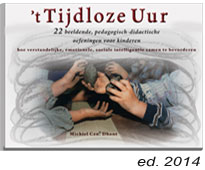
Major object: Harmonizing the 2 hemispheres of the Childs brain in ’Learning by doing’ benefiting both children and tutor, their relationship and the process of knowledge exchange. Target group - Tutors and Remedial Teachers in Education and Counsellors in Health Care. This book is a unique method which furthers expression by movement from intuition leading to tranquillity of the mind through training in individual and collective drawing- and claywork exercises. Learning by doing in which a child can discover its power of exploration, the expression of itself and its ability to exchange experiences. Because of the completeness of the method, these skills stimulate the integrationo all talents of the left -and the right hemisphere of the brain. All exercises in The Timeless Hour link up with universal human principles and are not bound to culture or nationality. The emphasis in The Timeless Hour is on pedagogics. Tutors don’t have to be skilled in any field of art to apply it’s method. |
||||||||||||||||||
|
||||||||||||||||||
|
Since nowadays society is evermore complex, it is
important that children develop and integrate the three types of
intelligence: cognitive-, emotional- and social intelligence.
Children as well as adults are confronted with deeply touching developments. It is their task to give sense to these events and to make conscious choices in the realization of their lives, in private life as well as in there profession. |
||||||||||||||||||
Mental and social wellbeingThe visual exercises in this method are a means to the major object of
mental and social wellbeing. They are not meant to create esthetic
artwork or to develop creative-art faculties. However, they certainly
contibute to creativity in all art- and creative subjects. Scientific fields - The vision and the exercises in this workbook correspond
closely with the development in the last 30 years of sciences as
pedagogy, neurology and social philosophy.
|
||||||||||||||||||
|
------------------------------------------------------ ------------------------------------------------------
Research at the Training-Institute for Art Therapy, Utrecht, The Netherlands medium: visual arts Naqiba
Bergefurt
Subject: Research Research into the method of the Timeless Hour that author Michiel Czn. Dhont describes in his book . Regarding to its possibilities for Art Therapy; a case study in respect to its merites in the sense of prevention with immigrant children with developmental problems.
On the Author of this research Naqiba
Bergefurt (1954) studied pedagogy at the
university in Utrecht / the Netherlands, worked with children in
various settings like
special care and a development project in New Delhi.
On the research group The study took place at a Primary school where more than 80 % of the children has an immigrant background. All these children have language problems and many of them also have social-emotional problems as a result of there not being integrated in the Dutch culture.The girls often show a lack of selfrespect and self confidence, resulting in withdrawl from or overadaptation to the group. The boys cover their disrespect with acting out or nonadaptation in their behaviour.
Planning
of the sessions The
course consisted of 9 lessons, one hour weekly, to a group of five
children, 8 to 10 years of age.
Outcome of the research All
the children were somehow out of balance. The
basic drawing exercises
are a very good diagnostic instrument
to show tensions or lack of
structure. In
two of the children I saw too much tension (also
fysically) and great problems to find cohesion and inner direction. Another
girl was too fat,
very passive and depending, showed no emotion or expression. The
fourth girl, who was very
silent and controlled, broke out of her role pattern and rebelled and
relaxed. The
only boy in the group felt
frustrated, which was more due to his
temporary situation than to any personality
problem
(he has just arrived in Holland).
After the boy quit the girls became more relaxed and enjoyed more what they did!
Please,
for
more information on this theme / research you can mail to: -----
Reactie
van een Kunstzinnig
therapeut / Art Therapist / the Netherlands
Ik vraag mij af in hoeverre deze oefeningen toepasbaar zijn t.a.v. zeer moeilijk lerende kinderen en welke ervaringen zijn er op gedaan tot nu toe hiermee.
Art
Therapist / the Netherlands My
name is Silvia Fiorini
and I am studying to become an
Art Therapist at the Academy for Art Therapy at Leiden / the
Netherlands. In short: ---
|
||||||||||||||||||
|
||||||||||||||||||
| REFERENCES All people mentioned below are working with "The Timeless Hour". They are willing to tell you more about their experiences with the method. |
||||||||||||||||||
|
NEW:
Cas Rooseboom working in Kenya...with 'the Timeless Hour'
------- Joke Zonneveld info@jokezonneveld.nl
In
samenwerking met Irma Vroegop biedt ze de mogelijkheid aan op school
zelf
voorbereidende lessen te geven rond hetzelfde thema, gekoppeld
aan
oefeningen rond “Geweldloze Communicatie” . meer
informatie op www.jokezonneveld.nl en www.ikvolgje.nl
Reactie
van een leerkracht op onze activiteit:
7
de klei laten wakker worden / 'let the clay become awake'
15
diepe aandacht / 'deep concentration'
20
de klei voelen / 'to feel the clay'
21
de veilige plek / 'a safe place'
40
aan het tekenen / 'go and draw'
kortom
een fijne herinnering aan een prachtige les
/
'in short: pictures of a wonderfull rememberance to a fine lesson
in 'learning by doing' with children'.
Simone Rosier, art-therapist and trainer of children, their teachers and teams at primary schools. Privat courses and consultations. Job van Velsen - Director Primary School / Tutor / Chairman of initiating new methods of “inclusive learning” and structures in Teaching in the Netherlands. J.Velsen1@chello.nl By Mrs. W. Uitgeest
– Tutor Hogeschool Leiden, The
Netherlands / artist / publisher / Art Therapy – bachelor degree. “For school and schoolteams we recommand the creative and existential approach as described in ‘The Timeless Hour’ by Michiel Czn. Dhont.” Scientific exchange in ‘learning by doing’ of the book ‘Linkedness’ and The Timeless Hour. Both books are about scientific exchange and acting in practice with children in many different circumstances. Anouk Depuydt and Gie Deboutte – Authors of project ‘Verbondenheid’ (‘Linkedness’) / University of Leuven, Belgium Dept. of Didactic and Pedagogic sciences. www.verbondenheid.be anouk.depuydt@law.kuleuven.ac.be info@verbondenheid.be It is important to really follow the method and repeat it several times. Take your time! A well prepared lesson is the power to succeed.” Dick Visscher – Tutor and former director of a public primary school, Hardenberg, The Netherlands. dick.visscher@planet.nl gerarddirks@hotmail.com ------ Luciette is working in a partnership, combining verbal and/or body therapy with expressive art therapy. Dear Michiel, I want to offer an example of the counseling of adults, where drawing out of movement and modeling with clay have had far-reaching results through a combination with Social Artistic Therapy. In an individual counseling I met a woman who had the feeling in her life that she was stuck in a set pattern, where verbal therapy did not provide the desired results. Out of the basic locomotion I guided her to the swaying balance movement, where she herself felt the need to work towards ‘The writing”, specifically the staccato. In the alternation of staccato and melodic movement memories and images began to surface of an isolation chamber where she had spent time 16 years ago when she was admitted due to post natal depression. Feelings of powerlessness, sadness and anger surfaced, but also her expression of power, which surprised her and also gave her a liberated feeling. When I asked her which animal she could experience in this, she modestly indicated a cat, but in reality is was more like a lion! Through the task out of expressive art therapy to build a lion out of yellow clay, she has step by step been able to give a form to her 'snowed under force' and has integrated it into her daily life. Another possibility for me to integrate Michiel Dhont’s method is in learning to express my own individuality. As my thesis I want to do a study into the effect of using both hands as well as only the right and left hand with all the visual techniques of expressive art therapy to stimulate the halves of the brain which can occasion a complete harmonisation of man in his healing process. (Translation: Liesbeth Rientjes) |
||||||||||||||||||
|
||||||||||||||||||
Inner Images coming to lifeThe timeless hour in elementary schools. English translation of an article appeared in the Dutch magazine ‘Educare’, year 19, nr. 1, 2001. Author: Margaret Bloemhof
Participants help themselves to coffee or tea. An easel carries a large board, a fresh sheet of paper tacked onto it. On the floor a circle of meditation-pillows. The main part of the room is empty. The place radiates frugality and a sense of purpose. All is ready for a day of drawing called ‘the Timeless Hour.’ During many years of working with students of all ages Michiel Dhont has developed a series of exercises aimed at developing ‘unity of head, heart and hands.’ The remarkable images that are the fruit of his approach, cannot but make one curious as to what it is that brought them about. Michiel, artist and musician, works with silence and movement, has students alternate between the dominant and non-dominant hand when drawing, use both hands at the same time, insist they don’t only knead clay but also feel and sense it, has objects change hands many times while being ‘worked on.’ This starts a process that will integrate the working of both hemispheres of the brain, release tension, lead to awareness of one’s creativity, enhance body-awareness, balance ‘felt senses’ and mental-cognitive powers. Michiel’s students are adults as well as primary school children. Catering to the latter group, the beautifully styled book-cum-video ‘The timeless Hour’ shows Michiel’s approach in 22 exercises that can be followed by schoolteachers wanting to link art-work and inner development. Applying these exercises opens a way for children to get to know their ‘inner images’, allowing an interweaving of perception and experience. The exercises stimulate intuition and help children to become ‘complete’ human beings. Today we will experience the working of it all, hands-on. So it’s to the virgin sheet of paper we go, that is, after a short self-introduction, a movement-exercise and, last but not least, the putting away of our watches. This is to be a day outside the confines of time! We seat ourselves in a semi-circle in front of the easel. A kind of dance begins, in which one after another, sometimes two at a time, piece of charcoal in each hand, we participants draw our traces, witnesses of an inner movement that wasn’t known until this very moment, leaving marks of a highly individual ‘us-ness.’ We produce a drawing for all of us, yet possessed by no-one. In so doing we run into our conditionings regarding ‘me and mine,’ (in)tolerance of what others are adding, the taking and passing on of our turns. It is fascinating to see everyone’s responses, and to find how as a group almost instantly we form some kind of ‘body,’ a whole that is more than the sum of its parts. The ‘old hands’ tell us how different is each drawing made in this way, showing each group’s ‘soul’ to be unique. Soon all awareness of time and hour disappears, replaced by crystal-clear attention and an open space in which the unexpected can take place. After lunch we are each given a piece of clay that we roll into a ball and with which we connect in various ways: we hold it in our hands and feel it with eyes closed, we throw it in the air and catch it in different ways; in pairs and with closed eyes we knead it into a form that we hand to our partner at the signal ‘exchange.’ Silently we ‘feel through’ the object we receive and continue working on it. This exchanging is done many times; the series is closed by bringing the object to our forehead and observing it; from a distance, from real close by. The object and the process of creating it are re-felt and incorporated. There is a short verbal exchange on what took place. Next a drawing in crayon is made, a distillation of the process of working with the clay. Next comes painting, gouache on wet paper. We moisten the paper with our hands and ‘glue’ it onto one of the many boards by the wall, silent witnesses of countless other paintings that have originated here, in the empty squares in the middle, bordered by left-over traces of color, ineradicable, growing with each new painting that is being made. We
cover the paper with a ground color, again using our hands. Then we may
continue with brushes, but I have acquired a taste for this and using
my hands I fill the paper with dots and lines in one color after the
other. We close the day looking at all the paintings, sensing each one
of them; a short tour through a New Age where the artist in each one of
us is coming into his own. This is marvelous, this really feels great.
Then the clay is returned to its
original form and stored away, well moistened. Containers, boards,
brushes and palettes get meticulously cleaned. All is ready for the
next round.
Teaching a ‘Timeless
Hour’ Rudolph is a graduating artist, who studied with
Michiel for a three year period, following every course in sight. A
friend introduced him to the extra-curricular activities at a school in
a deprived neighborhood of Amsterdam. Students there form a
multi-ethnical population, have poor linguistic skills and many are
hyperactive. Rudolph used Michiel’s approach “..in my own way of
course, otherwise it won’t work.” Ages in his groups ranged from 7-12 .
”The age difference wasn’t so
important. Once I had managed to get the group interested, everyone
could participate in their own way.” Rudolph used music a lot.. He had
children draw to the sounds of music with eyes closed and saw how the
rhythms were expressed in their drawings. The children liked this. To
his surprise he found that verbally weak children often were really
good at drawing. The most difficult children were good in this field.
“For these children, who often get a lot of negative attention because
of their constant fidgeting and lack of concentration, it was great to
discover something at which they were good and which elicited a
positive response. At first
Rudolph, as one of those ‘alternative guys,’ was eyed with caution.
Once he had won the teachers’ trust he could pretty much do things the
way he wanted. “But I had to adapt as well. Teachers at a regular
school won’t buy a completely holistic approach. Not to mention the
students. At ages eleven or twelve they start judging their work by outside values. In this kind of work you can get
over that during a session. There is no telling if any of it will stay.
For me this work is totally uplifting. It approaches these children in
a way that is not found elsewhere. I
seriously consider getting my teachers’ license. Of course there are
restrictions within the field of teaching Art. But I think it’s still
possible within these limits to do a lot!” |
||||||||||||||||||
|
English translation of an interview in the Jonas MAGAZINE number 57, May 2002, The Netherlands. |
||||||||||||||||||
This reflects the effects and comments of the tutor and the
children regarding the application of the exercises from The Timeless
Hour by author Michiel Czn. Dhont. In the playroom of primary school De
Vijzel in Heerhugowaard a long piece of paper is lying on the floor and
nine pupils, all seven or eight years old, sit down behind it, next to
each other. They have selected two bags of
crayons to draw with, one for the left and one for the right hand. They
will shortly start drawing with both hands. With eyes closed and to the
rhythm of the music. The pupils call the lesson ‘ write-dancing’. Tutor
Corrie Schouten, not only
vice-principal of the Primary School De Vijzel, but also nursery school
teacher and remedial teacher for locomotion defects, switches on the
music.
Not comfortable in their skinReview in Dutch Magazine 'JONAS' / Education & learning.According to tutor Corrie Schouten these children from groups three and four have a weak locomotion and problems concentrating. One child a little more of the one, the other child a bit more of the other , but all of them “are not comfortable in their skin”. Every week she has the group for over half an hour. The lesson always starts with moving to the music. Corrie Schouten has been giving these lessons for ten years. She uses different methods and for about a year now has also been using the working method of ‘ The Timeless Hour” which was published in 2000. Corrie Schouten: “Then you can be yourself. By drawing with both hands, both sides of the brain are stimulated, as the left side of the brain guides the right hand and vice versa. Meanwhile the children hear the music, by closing their eyes they exclude the outside world. There is no control of the hands through the eyes. This stimulates feeling. They are therefore active in various areas simultaneously. They feel, they hear, they move, they reflect. Basically the exercises teach the children to recognize and use their own abilities in both the cognitive and emotional areas”. Pupil Bas about the exercise: “With my eyes closed and with the music I can think well. About how you are going to move over the paper with the crayon. I like that. You don’t think about anything else.” Daniza prefers the rubbing out of the crayon. “That feels soft.” Just as at the beginning of the lesson, when the fists were still clean. they feel one hand with the other. It is quiet, only the sounds from the schoolyard permeate into the play room. After a few minutes, the eyes may be opened. What have they felt? Does it feel different than before when they had not yet drawn with crayon? Nigel: “ My nail is still smooth”. Linda points to the palm of her hand: “ This has become soft. And warm. And a bit sticky.” Robin feels nothing. “Nothing at all?” Corrie Schouten asks. “No”. “Are they warm? Or cold?” Robin, after a few seconds thought: “Warm.”. And in reply to the following question if he does not feel anything else, after another pause: ”And soft.” BlockadeLater on Corrie Schouten says about this: “When questioned Robin started to feel all sorts of things. My goal is that in a year from now he will reply to the question what he is feeling without any assistance. At the moment he still has a blockade: “I feel nothing.” According to her especially perfectionist children have trouble is just drawing something. “Just now, when we started drawing to music, one of them quietly asked me what he should draw. But we are not going to draw ‘something’, we are just going to draw. Perfectionist children want the drawing to be beautiful. That is the left side of the brain acting up. It more or less says: “This is the right way and that is not.” The drawing exercise is not meant for drawing a beautiful house. It is meant for stimulating the pupils’ emotional side. Just as the feeling of the hands. You make them aware of that feeling by letting them work with it. It is different from learning the table of three. That is important too, but that is the left side of the brain. That is activated all through the day. For instance, another time you exercise feeling is by kneading clay. The children make discoveries. They consciously experience that there is more than just their brain. That their bodies have all kinds of senses that they can name, feel and bring into play. I notice that it works this way because eventually the children themselves start talking about what they feel.” Pupil Daniza finds the “feeling” the most pleasurable. “We have also done it with clay. Then you have to knead and then exchange with someone else from the group. The other person’s clay felt so different. That was funny.” How that Corrie Schouten notice that the children with an exercise become more ‘comfortable in their skin’? Schouten: “It often happens that after they have been busy, when they have finished they say: “ That was nice miss, when can we do it again?” They have felt comfortable, they have been themselves during that period of more than half an hour. What more can you achieve? Of course they go back to their regular class after the ‘write dancing lesson’. And there is once again more than enough attention for the cognitive. But even if they will have a tutor who only stimulates the cognitive side for a number of years, once the balance between emotion and reason has been introduced, they will never lose it again. I notice it when I see them again, sometimes years later”. (Translation: Liesbeth Rientjes) |
||||||||||||||||||